This tool is for research, policy analysis, and education only. It is not operational SSA, a collision-warning system, a maneuver-command tool, or flight-safety decision support.
AI-LEO Policy Simulator
A research-grade SGP4, policy-simulation, and AI-triage platform for multi-operator LEO governance analysis.
Why multi-operator LEO governance matters
Low Earth orbit is becoming increasingly crowded as large constellations and multiple operators place more satellites into overlapping orbital environments. The governance problem is not only technical screening; it is also coordination burden, responsibility allocation, and fairness. When close-approach-like situations occur, who should act, who carries the workload, and how should responsibility be distributed across operators under uncertainty?
Understand it in 10 seconds
Generate synthetic LEO satellites
Propagate orbits with SGP4
Screen close-approach candidates
Compare R0/R1/R2 governance regimes
Rank unresolved coordination actions with bounded AI
The simulator turns orbital-growth scenarios into reproducible governance evidence, not operational alerts.
Start here
1) Understand the 5-step workflow
Read the 10-second overview and the research workflow diagram.
2) Compare R0/R1/R2
See the “Governance regimes compared” section below.
3) Open the demo preview
Curated 1000-satellite static preview (orbits, candidates, R0/R1/R2, AI triage).
5) Cite DOI when released
Prefer DOI-backed software and dataset records for citation.
Actual simulator preview
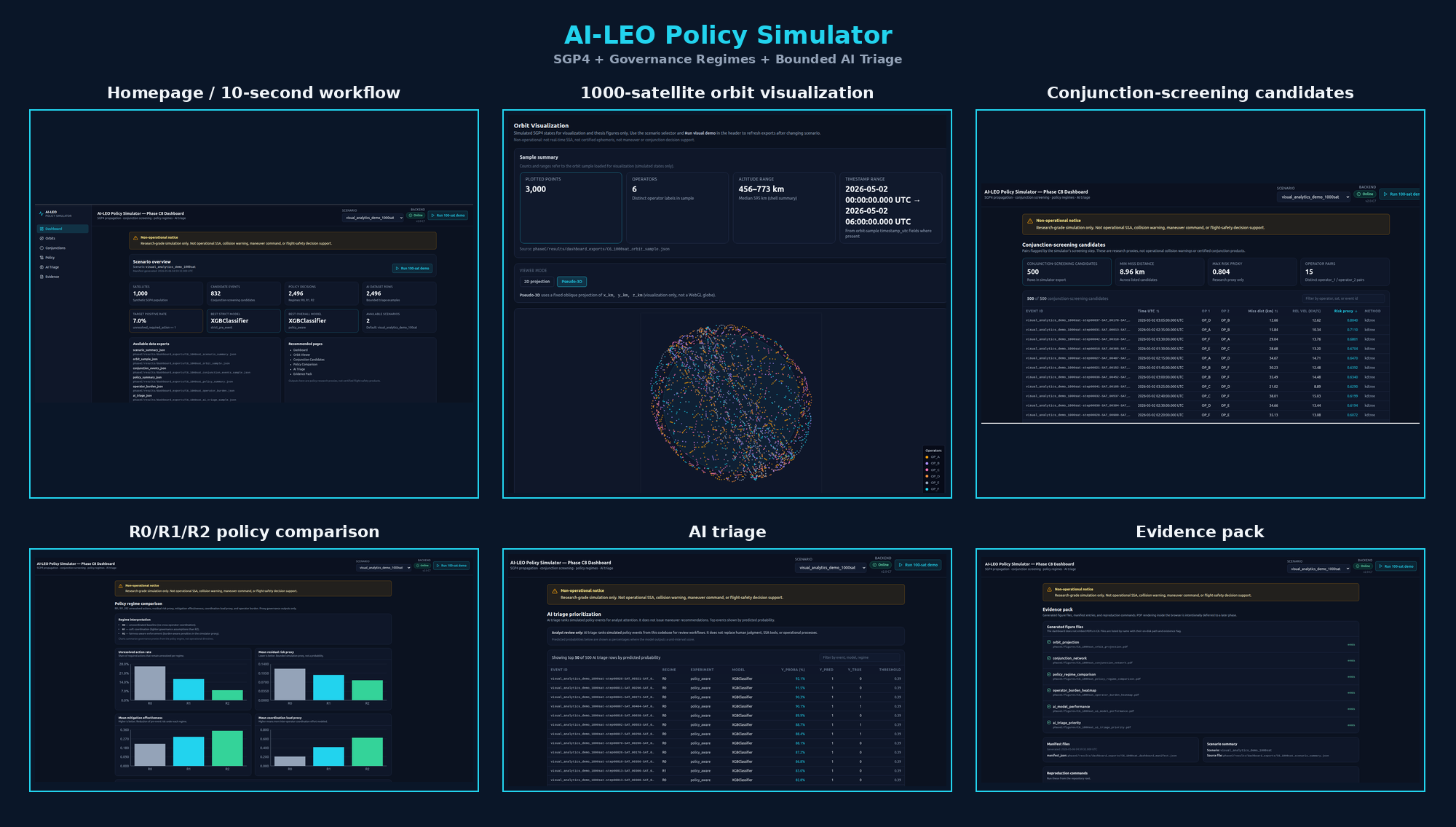
A public static demo preview is available using curated 1000-satellite outputs. It shows orbit samples, conjunction-screening candidates, R0/R1/R2 policy comparison, operator burden, and AI triage without exposing the live backend.
Screenshots
Overview of the Phase-C workflow: landing page, orbit visualization, conjunction-screening candidates, R0/R1/R2 comparison, bounded AI triage, and evidence/reproducibility.
Paper and preprint
- SSRN / preprint: https://ssrn.com/abstract=6679959
- Paper DOI: https://doi.org/10.2139/ssrn.6679959
Governance regimes compared
These regimes are simplified policy abstractions for research comparison, not real legal rules or operational maneuver procedures.
R0 — Uncoordinated baseline
Each operator acts independently. The simulator uses this as a baseline to estimate what unresolved coordination risk looks like when there is no shared coordination rule.
R1 — Soft / capability-based coordination
Responsibility is assigned mainly to the operator or satellite with stronger action capability. This represents a cooperative coordination regime without explicit fairness enforcement.
R2 — Fairness-aware allocation
Responsibility considers both action capability and accumulated operator burden. This regime tests whether governance can reduce unfair concentration of responsibility while still managing residual risk.
| Regime | Meaning | Main question |
|---|---|---|
| R0 | Uncoordinated baseline | What happens without shared coordination? |
| R1 | Soft / capability-based coordination | Does assigning the most capable actor reduce unresolved actions? |
| R2 | Fairness-aware allocation | Can burden be distributed more fairly without increasing residual risk too much? |
Key capabilities
Synthetic LEO population generation
Configurable synthetic populations for scenario studies.
SGP4 propagation
Standardized orbit propagation for research time series.
Conjunction-candidate screening
Geometric close-approach screening with transparent proxies.
Governance regime comparison
Compare R0, R1, and R2 proxy regimes on the same candidates.
AI dataset export
Structured exports for reproducible learning experiments.
Bounded AI triage
Prioritization support for analyst review workflows only.
FastAPI backend
Local read-first API for dashboard consumption.
Next.js dashboard
Local visualization of orbits, policy metrics, and evidence.
Reproducible evidence pack
Figures, JSON manifests, and documented regeneration commands.
How the simulator will be available
-
Public static website
Explains the workflow, shows screenshots, and provides quickstart files. -
Static demo dashboard
A future public demo can show pre-generated simulator outputs without exposing the backend. -
Local research simulator
Researchers can run the full backend and dashboard locally from the public repository after cleanup.
The live public backend is intentionally deferred until security review, rate limits, and job-queue controls are added.
How to use the simulator locally
- Start backend
- Start dashboard
- Click “Run 100-sat demo”
- Explore Orbits, Conjunctions, Policy, AI Triage, and Evidence pages
From the repository root (terminal 1):
python -m uvicorn phaseC.backend.main:app --host 127.0.0.1 --port 8000Terminal 2:
cd phaseC/frontend
npm install
npm run dev
Open: http://localhost:3000
Research workflow
Dashboard pages
- Dashboard —
/ - Orbits —
/orbits - Conjunctions —
/conjunctions - Policy —
/policy - AI Triage —
/ai-triage - Evidence —
/evidence
Evidence pack
The Phase-C prototype produces a reproducible evidence trail: dashboard exports, figure manifests, and command-line regeneration steps documented in the repository’s Phase C materials. When the repository is cleaned for public release, curated archives may be linked with DOIs (see citation section). This static page does not host downloadable bundles; it describes the workflow only.
Cite and reuse
For formal citation, cite the SSRN paper now. After public release, cite the Zenodo software DOI and the Zenodo/Figshare evidence-pack DOI. Website pages improve visibility; DOI-backed archives remain the durable citation targets.
Current citation status
- Paper DOI: 10.2139/ssrn.6679959
- Software DOI: https://doi.org/10.5281/zenodo.20049013
- Evidence-pack DOI: https://doi.org/10.5281/zenodo.20049035
- GitHub: https://github.com/reehan79/ai-leo-policy-simulator
- ASR article: under review
SSRN page: https://ssrn.com/abstract=6679959